


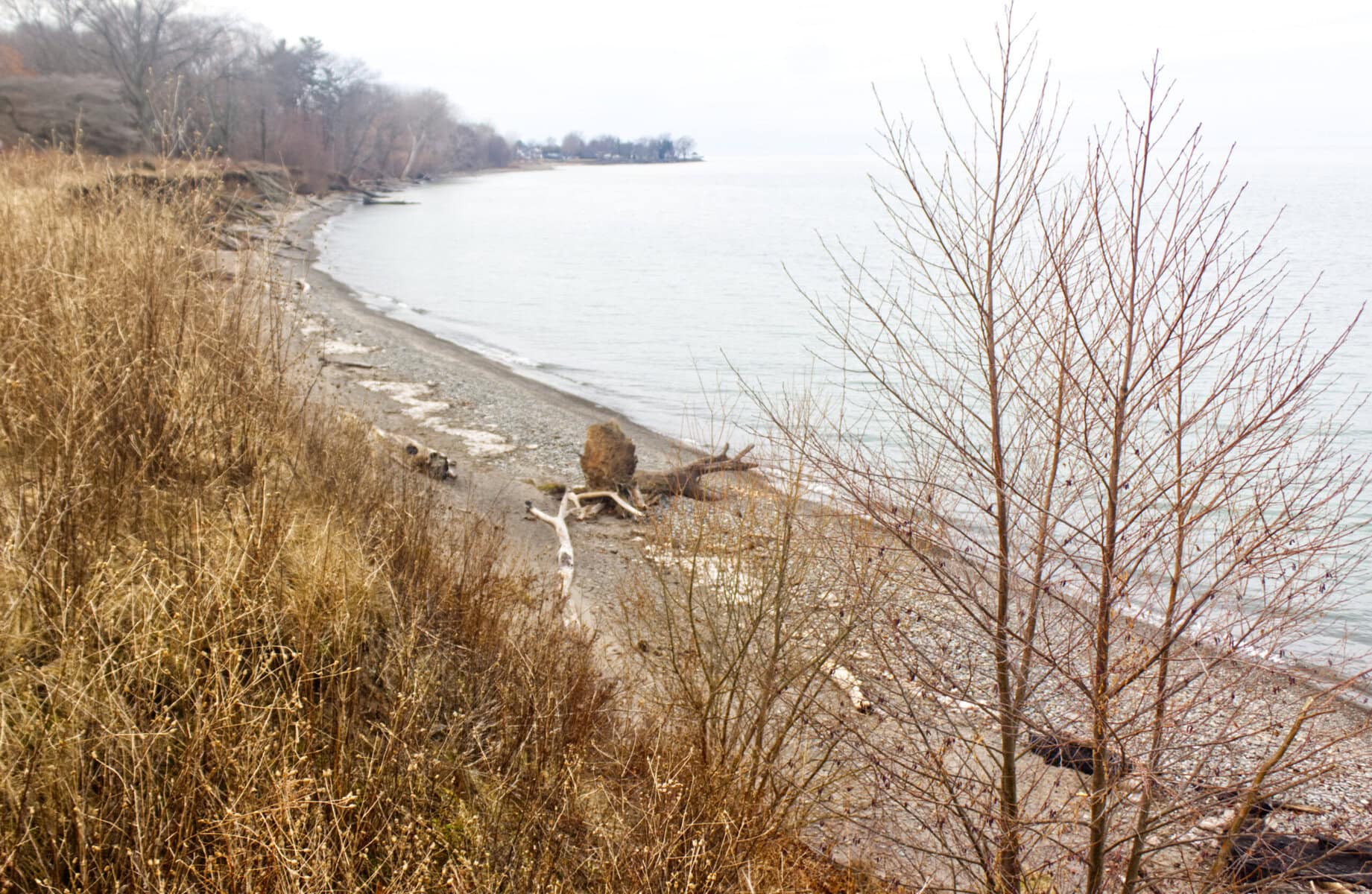


People visiting Niagara Shores Park can expect changes over the next five years, including habitat restoration, more trees and what officials say should be a better overall visitor experience, as the Niagara Peninsula Conservation Authority enters into a new management agreement with Parks Canada.
The move could be welcome news for a park that has suffered from erosion and environmental damage for decades. A 2019 Lake Report investigation found the park had lost about 90 metres of land since 1950, while Parks Canada has said shoreline erosion continues at a rate of roughly 1.1 metres per year.
The park’s bank swallow population has also been under threat as eroding banks collapse into Lake Ontario. The species has experienced an overall population decline of about 90 per cent since 1972.
Jennifer McQuillan, communications and marketing specialist for the Niagara Peninsula Conservation Authority, said the authority is undertaking the Lake Ontario Coastal Resilience Pilot Project to better understand shoreline erosion and habitat preservation, with findings that will apply to Niagara Shores Park.
“Niagara Shores Park represents a natural hazard site within the watershed and is well positioned to be included in the case studies and technical assessments undertaken through this broader regional effort,” she said.
“The outcomes of the Lake Ontario Coastal Resilience Pilot Project will help inform practical, locally tailored solutions to reduce shoreline hazards — such as the eroding bank at the Niagara Shores property — while also considering natural habitat protection.”
“While it is still early in the process, Niagara Peninsula Conservation Authority staff will be developing an internal work plan for the Niagara Shores property, anticipated to be completed by Spring 2026.”
Under the agreement, the conservation authority will manage Niagara Shores Park until 2031.
Julia Grcevic, public relations and communications officer for Parks Canada, said the authority will “administer these park lands, making them responsible for any infrastructure, environmental impacts, visitor needs and public safety.”
McQuillan said the agreement allows the conservation authority to carry out habitat restoration and tree planting, as well as ecological research and site studies.
She said the authority can also collaborate with Parks Canada and the Town of Niagara-on-the-Lake on site planning and management, including visitor improvements such as trail maintenance and new signage.
Ownership of the land will remain with the federal government, she said.
Niagara Shores Park is a 14-hectare forested area west of Old Town along Lakeshore Road in Niagara-on-the-Lake.
Parks Canada currently manages the park under the National Historic Sites program. The agreement, which took two years to complete, is intended to allow the conservation authority to, as Grcevic said, “manage land to increase biodiversity, habitat connectivity, and natural cover” and “create equitable access to greenspace for the health and well-being of people.”
The agreement establishes a licence of occupation, a temporary arrangement that allows the conservation authority “some privileges” to manage the property “without completing a transfer of lands.”
Those privileges include conducting research and studies, caring for the land and working with the community and interested partners on a land management plan to determine “the appropriate use and management” of Niagara Shores Park.
The agreement also allows the site to be considered as a case study location for the Lake Ontario Coastal Resilience Pilot Project, which addresses ongoing natural hazard issues.
In addition, the conservation authority may work with the town on “parking enhancements at a nearby property to provide a safe entry and crossing to Niagara Shores Park.”
McQuillan said the agreement is expected to be finalized in February and that “visitors can expect the park to continue being managed as a natural area, with no significant changes to the experience in the near term.”
The conservation authority said the agreement has no financial implications beyond an annual $100 administration fee, with costs already included in its operating budget.
The conservation authority previously managed the park from 1980 to 1993. A report outlining the agreement noted that “due to vandalism and repeated damage to the grounds, vehicular access to the park has been restricted and Parks Canada encourages access by foot or active transportation.
daniel@niagaranow.com