

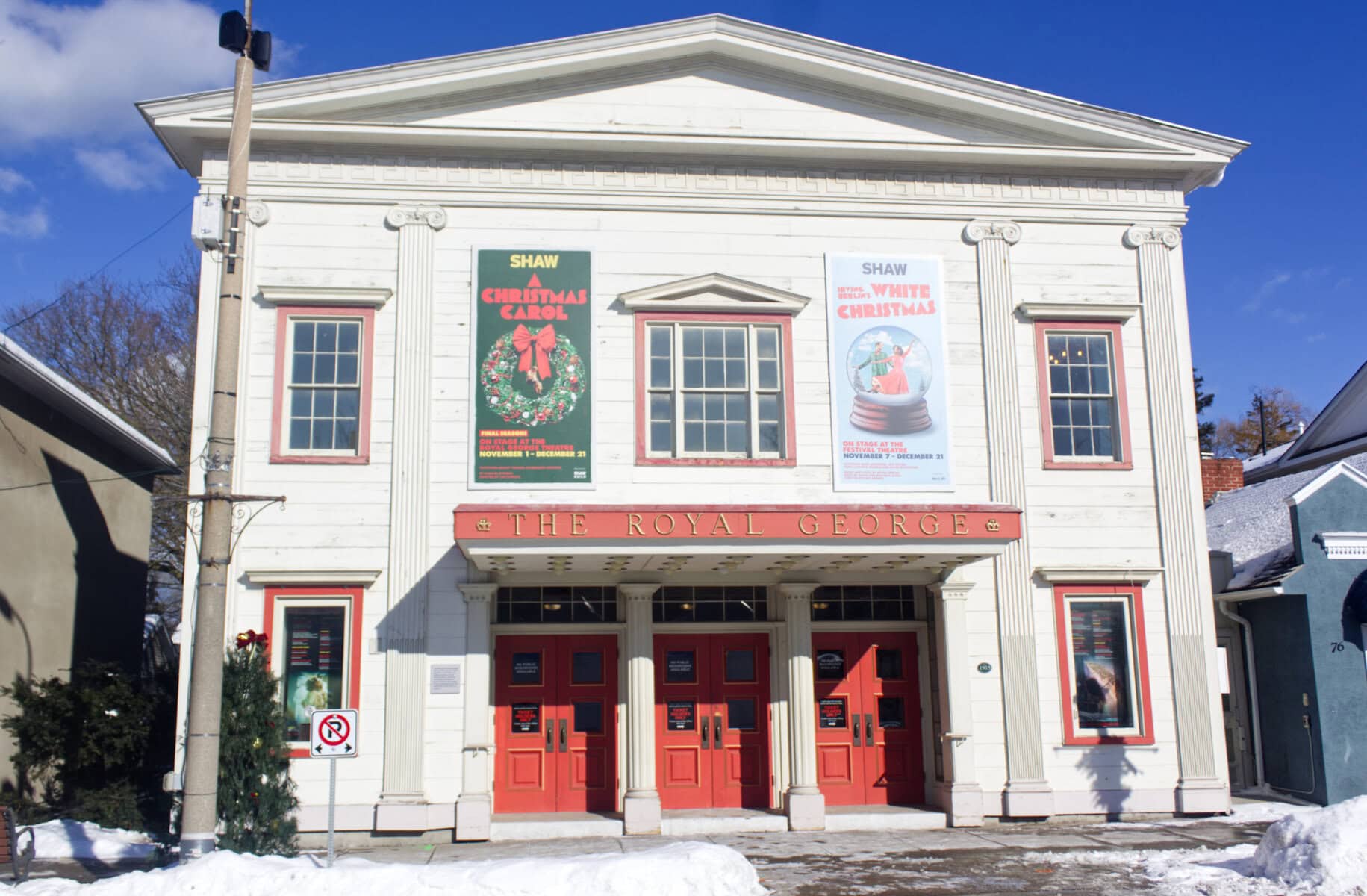


With council approvals now in place to allow the Shaw Festival’s Royal George Theatre to be torn down and redeveloped — and the venue already closed as preparations move forward — a Niagara-on-the-Lake business has launched a judicial review challening whether the municipality followed the law before clearing the way.
Opponents of the project argue that once the century-old theatre at 79–83 Queen St. and 178–188 Victoria St. is demolished, any heritage loss would be permanent — a concern at the centre of the court challenge.
Centurion Building Corporation, led by president Nicholas Colaneri, submitted the application to the Divisional Court in Toronto. It is awaiting issuance and no hearing date has been set. The Corporation of the Town of Niagara-on-the-Lake and the Shaw Festival are named as respondents and the Attorney General of Ontario is named, as required under Ontario law.
The town’s heritage committee gave the green light for the teardown of the theatre in January and Shaw Festival officials said demolition permits have been applied for, with work expected as early as late February or March — it opened its doors for the last time to the public Jan. 31.
In the application, Centurion Building argues the town overstepped its authority by approving planning changes that conflict with provincial, regional and local planning rules, including policies meant to protect heritage properties.
“This judicial review is not about whether people like or dislike the Shaw Festival and it’s not about opposing theatre or culture,” Colaneri said in an email. “It is about whether the town followed the law.”
The company alleges the town relied on zoning assumptions that contradict its own zoning bylaw, failed to properly apply the Ontario Heritage Act by not prioritizing conservation or fully assessing alternatives to demolition and ran an approval process that was unfair — relying on incomplete or conflicting information and separating planning and heritage decisions instead of considering them together.
“When a municipality fails to follow those laws, the courts are the only place now that residents can go for accountability,” Colaneri said.
The application asks the court to review whether the town complied with its official plan and zoning bylaws, the region’s official plan, the Planning Act, the Ontario Heritage Act and the provincial policy statement, the document that governs land use planning in Ontario, when approving the teardown and redevelopment of the site.
It asks the court to quash the approvals, declare that the town acted unlawfully and unreasonably and pause the town’s planning approvals while the application is decided.
“My position is simple: let the court decide first, and then allow work to proceed only if the approvals are confirmed to be lawful,” Colaneri said.
In a statement, he said the review is not an appeal of design choices or development policy, but a legal challenge focused on whether council followed mandatory legislative requirements — particularly in a designated heritage conservation district.
“Once demolition occurs, heritage loss is irreversible,” the statement said, adding that Ontario law provides for judicial oversight to ensure decisions affecting protected heritage resources are made lawfully before irreversible actions are taken “and require that conservation be addressed as a first principle, not as an afterthought.”
“Regardless of one’s view on development or cultural investment,” the statement continued, “the integrity of the planning and heritage process matters.”