


More than two centuries ago, almost all of the buildings and homes that stood in the village of Newark (today, Niagara-on-the-Lake) were burned to the ground by American soldiers during the War of 1812.
One of the few homes that survived later faced the threat of flames again: being deliberately burned by a fire department for a training exercise.
Instead, the house survived again.
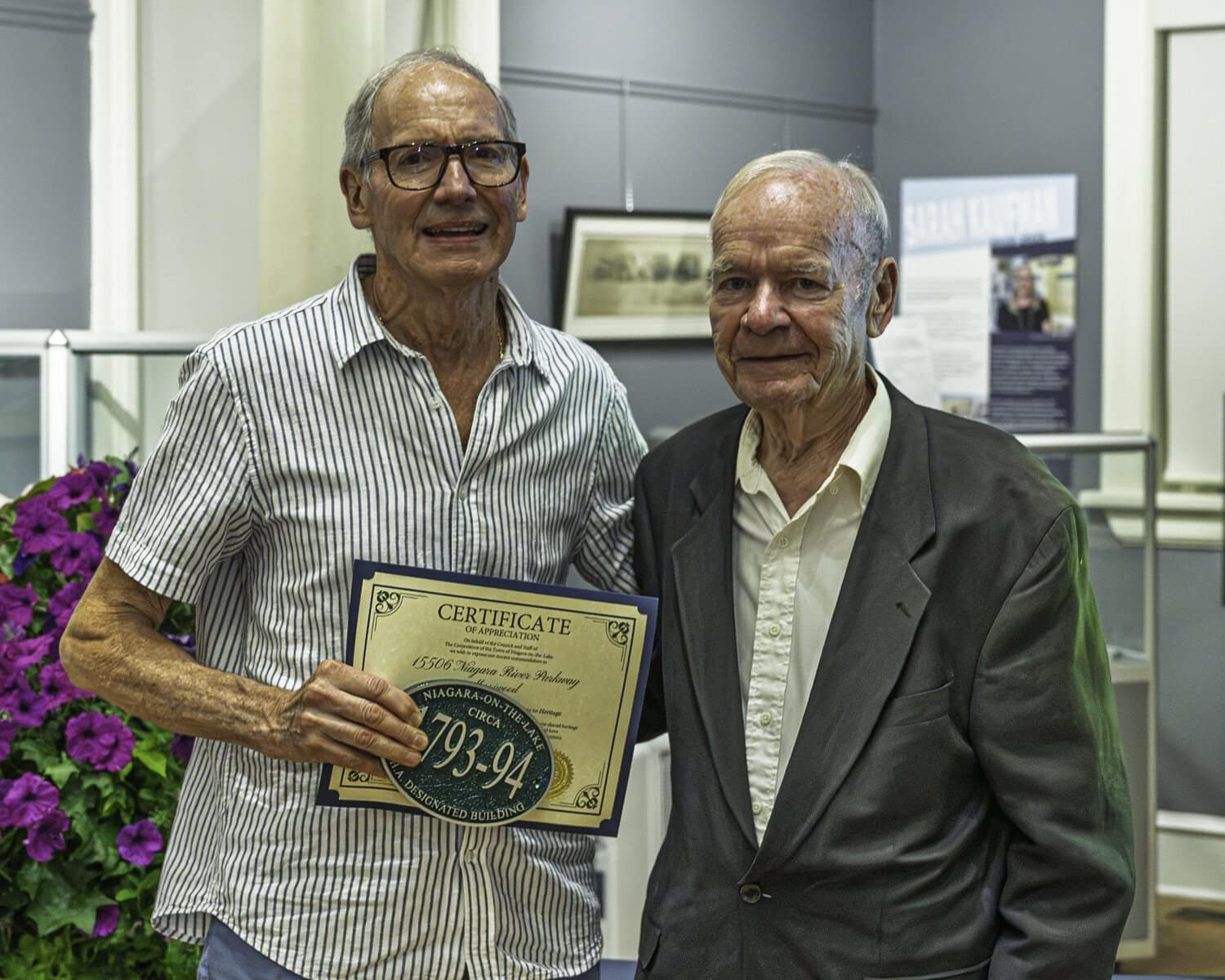
More than 60 years after a historical society saved it from destruction, the roughly 230-year-old home at 15506 Niagara River Pkwy., known today as Merriwood, was among nine designated properties honoured July 15 at the Niagara-on-the-Lake Museum.
Couns. Tim Balasiuk and Gary Burroughs presented heritage plaques to property owners alongside municipal heritage committee members Rita Trudeau and John Morley.
Built around 1793 or 1794, Merriwood is one of the town’s rare surviving buildings from before the War of 1812 and later served as a British military hospital.
Owner Richard Merritt said the house had fallen into poor condition by 1965 and had been given to the Queenston fire department to be set on fire during a training exercise.
“Fortunately, the historical society got wind of it and they stopped that plan,” he said in an interview.
The building was moved to Niagara Parks property near what is now McFarland House before being sold and relocated to its current site at Line 3 and the Niagara River Parkway.
Merritt and his wife bought the property 45 years ago and later built a large addition using woodwork salvaged from another demolished historic home. Both the original house and the addition are recognized as heritage features.
He said they considered designation for years before deciding it was the best way to protect the property.
“If you don’t want someone else to come in later and, you know, tear off a wing or make major changes,” he said. “This way, there’s some protection.”
The home also has ties to several prominent historical figures. It was built by Walter Butler Sheehan, a nephew of Col. John Butler, and sold in 1798 to French military officer Joseph-Geneviève de Puisaye, Comte de Puisaye.
Merritt said Elizabeth Simcoe, wife of Upper Canada’s first lieutenant-governor, John Graves Simcoe, and the province’s first attorney general, John White, were among those who visited.
Now known as Merriwood, a name combining Merritt’s family name with the historic woodwork additions and the property’s trees, the home continues to require extensive upkeep, including the eventual replacement of its cedar-shake roof.
“It’s more than the bricks and mortar. It’s the people that live there and their stories,” he said.
Burroughs said the recognition only hints at the effort Merritt invested in preserving the home.
“The presentation tonight doesn’t do justice to what Richard has done,” he said. “It’s amazing.”
The town also honoured properties at 1791 Concession 2 Rd., 18 Wilberforce Ave., 716 King St., 263 Regent St., 167 Four Mile Creek Rd., 1665 Four Mile Creek Rd., 115 Delater St. and 238 Four Mile Creek Rd.
Aimee Alderman, the town’s director of planning, building and development services, said the town has designated 21 individual properties since launching its priority designation work in 2023.
“Heritage is one of our community’s greatest strengths,” Alderman said. “It enriches our neighbourhoods, supports our local economy, reflects the pride people take in this community and connects us to the generations who came before us.”
The town’s heritage register includes 430 properties. Of those, 95 are individually designated, 152 are designated within the existing heritage conservation district and seven are designated under both categories. Another 176 are listed for their heritage value but are not formally designated.
The town has also approved an expansion of the Old Town heritage conservation district covering 533 properties, although it remains under appeal before the Ontario Land Tribunal.
Municipalities have until Jan. 1 to designate properties on their heritage registers under provincial rules introduced in 2022. Properties that are not designated by then will be removed from the register, making them easier to redevelop or demolish.
Coun. Erwin Wiens said Niagara-on-the-Lake plans to ask the province at the Association of Municipalities of Ontario conference in August for an extension to 2030.
He said about 150 properties remain to be addressed.
Alderman said preserving heritage depends on more than legislation.
“Every one of those contributions matters because heritage conservation is a shared responsibility,” she said.
Amanda Demers, vice-chair of the municipal heritage committee, said members work with owners to balance modern living needs with preserving historic features.
Lord Mayor Gary Zalepa said heritage designation has become more accepted in Niagara-on-the-Lake than in many municipalities.
“We are doing something in Niagara-on-the-Lake that is so much better than other communities,” he said.
“In other communities, heritage designation is not something people want to do.”
Zalepa credited owners for protecting their properties and said the town will continue pressing the province for more time.
“We’re going to keep pushing the province to understand that Niagara-on-the-Lake is an exception,” he said.