


Michael Ennamorato
Stephen Ferley
Special to The Lake Report
The 2026 municipal election results have been officially certified and final tallies can now be examined in detail by polling station and by online versus in-person participation.
An analysis of the results overall and at this level of detail allows us to make some observations that have some bearing on voter attitudes and the mandate conferred to Niagara-on-the-Lake’s new council.
First of all, it should be emphasized that NOTL residents spoke loudly and clearly. Voter turnout is typically strong in town and this election was no exception.
In fact, at 52 per cent, turnout was five points higher than that recorded in 2022, which is impressive for a municipal election anywhere in Canada. No doubt, wider acceptance of online voting and the convenience it affords may have had something to do with that.
Just over half (51 per cent) used the online option. However, it is also quite possible that many residents were more motivated to vote than they had been in the past and were engaged with the election earlier on.
This may have elevated participation rates and, with more people having already made their decision, could have driven wider use of the early online voting option. The important thing, though, is that a large portion of eligible voters engaged, thereby supporting the democratic process and legitimately empowering the new council.
And on the mayoral front, there was a clear winner, with Vaughn Goettler capturing 55 per cent of the overall vote (versus 31 per cent for Erwin Wiens and 14 per cent for Andrea Kaiser). Not only were the winds of change prevailing, but there was clearly strong endorsement of Goettler as the champion of change.
His lack of elected political experience may have been a benefit here. Despite her long history in local politics, Kaiser was only able to generate tepid support. And, as it turned out, her candidacy did not introduce a vote splitting factor, particularly given that Wiens, as a distant second, had an insurmountable gap to bridge.
While Goettler generated strong support overall, in a municipality such as NOTL composed of several distinct communities, the geographic distribution of his support has a strong bearing on shaping his mandate.
Analysis of the election results by polling station gives us some sense of how the vote varied by community. Though imperfect (after all, residents did not have to vote at the polling station closest to their place of residence), the polling station results are certainly a credible surrogate of support at the community or village level.
Here we find that Goettler dominated in the communities with the most extensive heritage assets to protect (Old Town and Queenston) garnering the support of roughly three out of every five voters in these villages. However, he was also highly competitive elsewhere.
Wiens achieved a narrow win in Virgil (44 per cent versus 41 per cent), but only managed parity with Goettler in Glendale (each at 41 per cent).
St. Davids has a unique mix of high-profile concerns related to large-scale development, flooding and the tie-in to infrastructure capacity, not to mention the ongoing roundabout drama. Goettler came out on top here — 46 per cent to Wiens’ 40 per cent.
Additionally, Goettler dominated within the online voting community (56 per cent versus Wiens and Kaiser at 30 per cent and 14 per cent respectively).
While the online results are not broken down by community, the geographic pattern evident among those voting in-person coupled with this dominant online showing strongly suggest Goettler achieved broad cross-community support among online voters as well.
The good news is that while overwhelming endorsement in Old Town and Queenston took Goettler over the top, he and his platform have a strong base of support everywhere. This gives him a solid mandate to act on behalf of the municipality as a whole.
There are differences in outlook and priority from one community to the next, but they are certainly not insurmountable. There is enough commonality to avoid polarization.
With regard to the councillors, it is telling that the incumbent candidates who voted in favour of the highly contentious Parliament Oak development were soundly defeated along with Wiens. And this withdrawal of support was not limited to Old Town.
In fact, with one exception, neither Maria Mavridis nor Adriana Cater Vizzari met the top-six threshold for electoral success at any of the in-person polling locations or among online voters.
The exception was Cater Vizzari in her home community of St. Davids, where she managed to take third spot. That is a resounding defeat for both of them given the incumbent advantage typical in municipal politics.
By contrast, the incumbents who have arguably been the most consistently supportive of residents and demanding of developers (Gary Burroughs and Sandra O’Connor) were rewarded at the ballot box.
Burroughs, with his long history of public service, was evidently not perceived as representative of the “old guard” but, instead, seems to have added additional impetus, propelling him to the position of deputy lord mayor.
Tim Balasiuk did not benefit to the same degree as these two, though he consistently held on to the sixth and final spot in all communities, with the exceptions of Virgil (second) and St. Davids (seventh).
Among the newcomers (and Andrew Niven is included here since this was his first election following a short, appointed term), all vowed to be resident-first and vociferously supported the primacy of the official plan and democratic principles generally.
Given what was observed on the ground, one of the key determinants of success or failure among these candidates might be traced to simply getting out early with a strong backing organization to knock on doors and articulate a well-honed message.
Niven, Weston Miller and Steve McGuiness fall into this category, with the first two also likely benefiting from previous community leadership experience.
Among those newcomers who were less successful, Nicholas Colaneri stands out as being in serious contention especially in communities outside of Virgil. Given his relative youthfulness, this bodes well for future attempts he might make to secure public office.
What we seem to have, in the end, is a new council that embodies the balance of experience and fresh ideas needed to responsibly take a new direction.
With no guidance from tools such as exit polls, we have no data to measure voter breakdowns by age, gender, income or other demographics, but the magnitude and geographic breadth of the Goettler majority clearly points to a strong mandate to represent NOTL in its entirety.
The presence of Burroughs and O’Connor on council should provide the new lord mayor with the well of experience he will need to draw upon as a novice in governance.
His rejection of strong mayor powers sets the stage, at least, for co-operation, compromise, consensus and teamwork. This is what the people want — and the people have spoken.
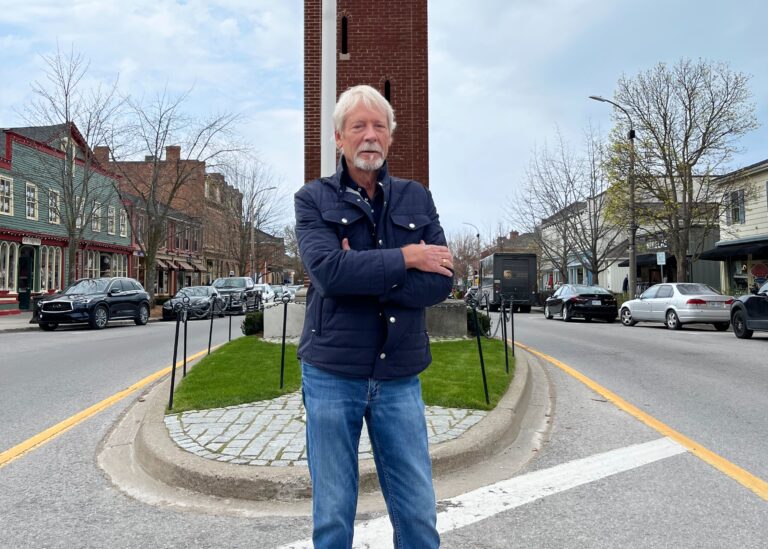
NOTL residents Michael Ennamorato and Stephen Ferley are experts in research and statistical analysis. Ennamorato is a social geographer and former president of TNS Canada. Ferley was president of Canada’s Print Measurement Bureau.