


Almost 300 flood reports are now on the books in Niagara-on-the-Lake after this summer’s two big rainstorms, but the full extent — and cost — of the damage is still being assessed.
On farms in town, the clock could run well into next year.
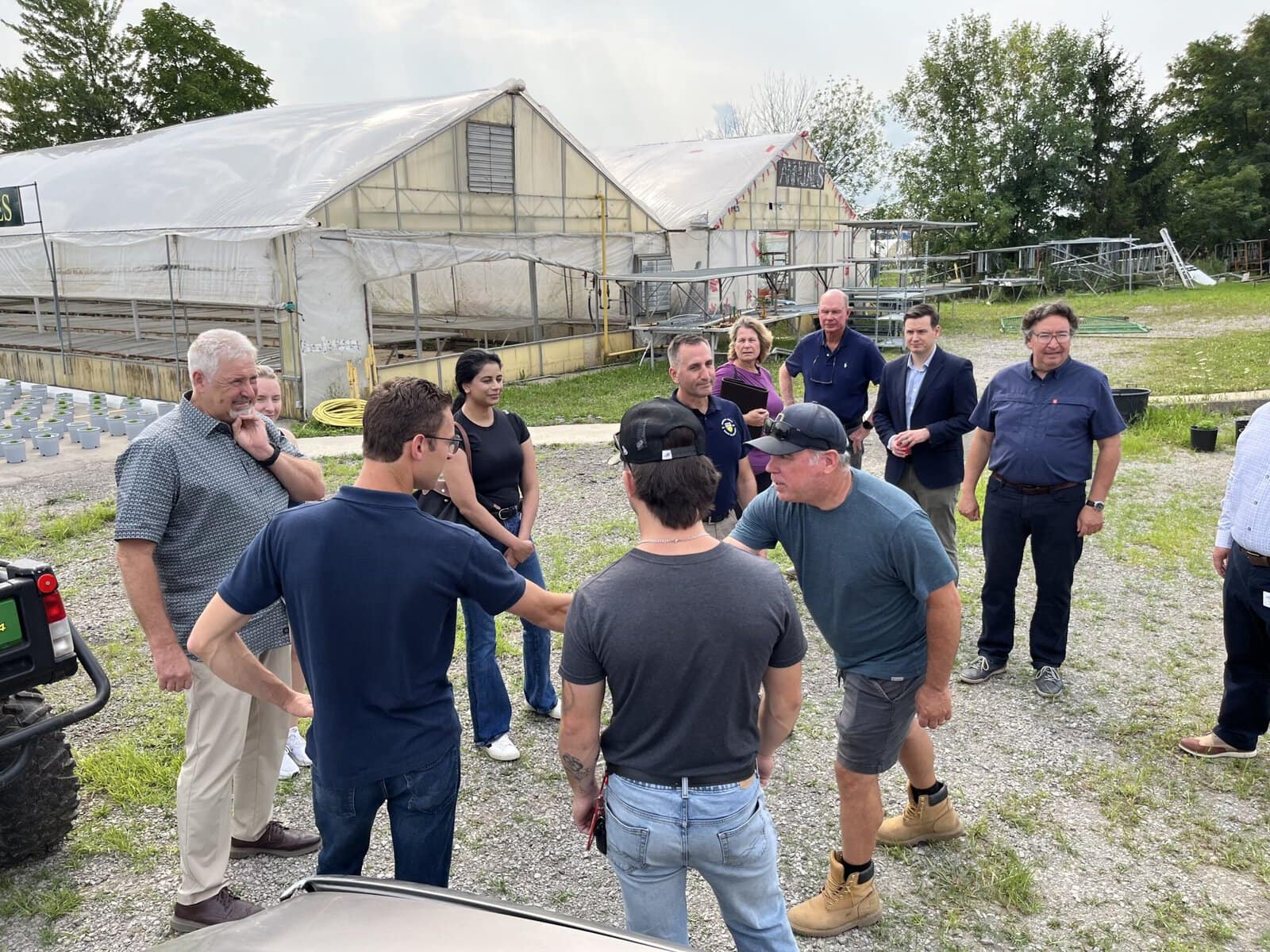
Provincial politicians have toured some of the town’s hardest-hit farms and seen the damage firsthand: Fields flooded. Fruit trees toppled. Equipment ruined. And trees that spent days underwater, which may not survive to bear fruit another season.
Now, growers want to see what comes after the visit.
Trevor Jones, the minister of agriculture, food and agribusiness, visited Seaway Gardens and Huebel Estates last week, but left without making any specific promises to help.
Coun. Erwin Wiens, who joined Jones and Sam Oosterhoff, member of provincial parliament for Niagara West, on the tour, said the group visited those farms because of the extent of the damage there.
Wiens, who is also a farmer but attended in his role as deputy lord mayor, confirmed there were “no immediate commitments” from the province during the visit.
Representatives from Ontario Tender Fruit Growers, Grape Growers of Ontario and Flowers Canada Growers were also there to make the case for help.
Among them was Phil Tregunno, chair of Ontario Tender Fruit Growers, who said showing up is only the first step.
“Politicians are pretty quick to come down for the photo op, but when we actually ask them to change some of the things, like insurance and site specific, they’re a little slow to move — if they move,” he told The Lake Report.
The three organizations say farmers are dealing with disease pressure, lost plants and unharvested crops, with some longer-term impacts still unknown.
They are asking governments for help in several areas.
For one, they want crop insurance for damaged vines and trees adjusted to provide site-specific coverage and account for actions they’ll need to take down the line, such as replanting vines and trees, as well as permission to use drones to spray fungicides in hard-to-access flooded areas.
Also, they’re requesting flexibility on inspection deadlines for temporary foreign worker housing to give them time for repairs and clean-up, and for governments to use AgriRecovery, a disaster relief support system, to help farms rebuild and recover.
For Tregunno, changing crop insurance to help cover specific areas is the most immediate need.
He said a grower can suffer severe flooding at one orchard but receive little or no compensation since the insurance calculation considers trees across the farm’s other properties.
“There’s growers in the area that were underwater for several days, so those trees will likely die,” he said. “But because they take the averages and your tree counts from other locations, then there wouldn’t be any compensation.”
Tregunno said the three organizations made their requests clear during the provincial visit, including the push for site-specific insurance.
“They’re well aware of our asks,” he said.
But since the visit, Tregunno said, growers have heard nothing further from the province.
The Lake Report asked Jones whether the province would support the growers’ requests, whether financial assistance is being considered and how much could be available.
In a statement, senior communications adviser Miriam Leardi said the government is working with the Town of NOTL and that affected farmers may be eligible for support through Business Risk Management programs.
She encouraged affected farmers to contact Agricorp at 1-888-247-1380 or at contact@agricorp.com for information about available programs.
Wiens said the town is now collecting information about the damage for the province as growers wait to learn what assistance may be available.
Although assistance remains uncertain, Wiens said the damage was difficult to miss.
“We saw farm equipment that had been underwater and ruined, greenhouse pots that had been washed away, grapevines and trees that had been underwater for a number of hours,” Wiens said. “We also noticed the onset of rot mildew and other damage to produce that was beginning.”
The agricultural damage is part of a much wider flood recovery effort still unfolding across NOTL.
By Monday morning, the town had received 282 flood-related service requests. Staff are investigating concerns involving culverts, ditches, drainage systems, sewers and other infrastructure and mapping reported flooding across the town, according to an Aug. 17 statement.
Asked to estimate the financial losses for NOTL farmers, Tregunno said it is too early to put a dollar figure on them because the more enduring consequences are still unknown and losses vary considerably between farms.
“In a lot of cases, we’re not going to see that damage till late fall or spring of next year,” he said of trees that spent days underwater.
Tregunno said he believes the second storm, which took place Aug. 2, was the more destructive of the two because the ground was already saturated from the storm five days before on July 28.
“The second one was definitely the most destructive,” he said.
After the first rainfall, Tregunno said he did not see trees falling or bending. After the second, peach trees carrying full crops toppled in the saturated ground.
Similarly, Wiens warned the consequences are not over.
“There was significant damage. There is concern for ongoing issues due to prolonged flooding,” he said.
“That damage will become evident in the days and weeks ahead.”