


HEARTBREAK HOUSE
*** (out of five)
Jackie Maxwell Studio Theatre, 2 hours, 40 minutes, one intermissions. Ends Oct. 3. By George Bernard Shaw. Directed by Tim Carroll.
Monday night’s prolonged electrical storm dislodged any possibility of slumber, which led to observing flashes of lightning and the rewriting of this review.
I wanted to wholeheartedly love Tim Carroll’s direction of this “Heartbreak House,” brought home once again to the Shaw Festival.
It is, after all, one of Bernard Shaw’s finest plays, if not the finest. One he struggled with and anguished over until he could reconcile its conflicts and bring its deeper meanings to relevant fruition.
In July 1916, Bernard Shaw was at a house party in Sussex, sitting on the terrace after dinner, when he heard the distant, ominous thunder of artillery on the battlefields of the Somme.
On July 1, British forces had launched their offensive and suffered 57,000 casualties. Such grave losses were to continue until 1918, a generation of young men gone.
For what?
“Heartbreak House” is a profound examination of generational change, of dreams and ambitions shattered by war, of industry and government overturning social programs in favour of exploitation.
It mourns the loss of idealism, manners, economic stability, the gains made by women, the demise of literature and the death of poets flung into the maws of death.
Only love can sustain the survivors. And only attention to its message, to the fine Shavian words, can save this production. It is demanding of its audience.
Into this bohemian ship of Captain Shotover is a house unmoored from reality. Tim Carroll has brought together his finest actors to guide us to understanding.
Julia Course is outstanding as the beguiling Shotover daughter, Hesione, by turns warm and compassionate or fiery in opposition when provoked.
Tom Rooney’s Captain Shotover achieves the remarkable balance of paternal sensitivity and grace with his “demon of Zanzibar” reputation of controlling his men at sea and avoiding wrecks on the rocks by a lifelong adherence to the importance of navigation.
Graeme Somerville is totally believable as the tough Boss Mangan, who beneath the hard shell and bluster of an industry giant, is a softy incapable of actual cruelty who longs to be loved.
Sochi Fried as Ariadne, Lady Utterwood, the other Shotover daughter, brings the required crispness of a woman bound to etiquette, respectability and her status as a colonial governor’s wife. She returns, 23 years after escaping, to the safety of home, but remains appalled by its irreverent bad manners.
Her father, the captain, wisely sees that her facade of cold heartlessness is a cry for love and to have her heart broken. She falls for her sister’s husband, the liar and philanderer, Hector Hushabye, played by Martin Happer with a loucheness not quite in keeping with a suavity one would expect.
Jason Cadieux is Randall Utterwood, the brother-in-law of Ariadne. She treats his puppy-dog devotion with utter contempt. Unfortunately, in this play of meaningful dialogues, Cadieux and Happner’s moment, was unheard by our section of the audience. We saw only the back of Cadieux’s head and heard nothing. And here is where we need to consider the mature, matinee audience.
Clever lines hardly raised a chuckle or recognition. Is Shaw no longer read? A standing ovation, au courant for anything and everything, did not occur at this matinee. It was worthy of one.
Are the tragedies of the First World War forgotten in the onslaught of current wars currently consuming lives yet easily forgotten in the maze of media coverage, reality television, iPhones and games?
Revelation. Shaw actually based this play on a game: chess.
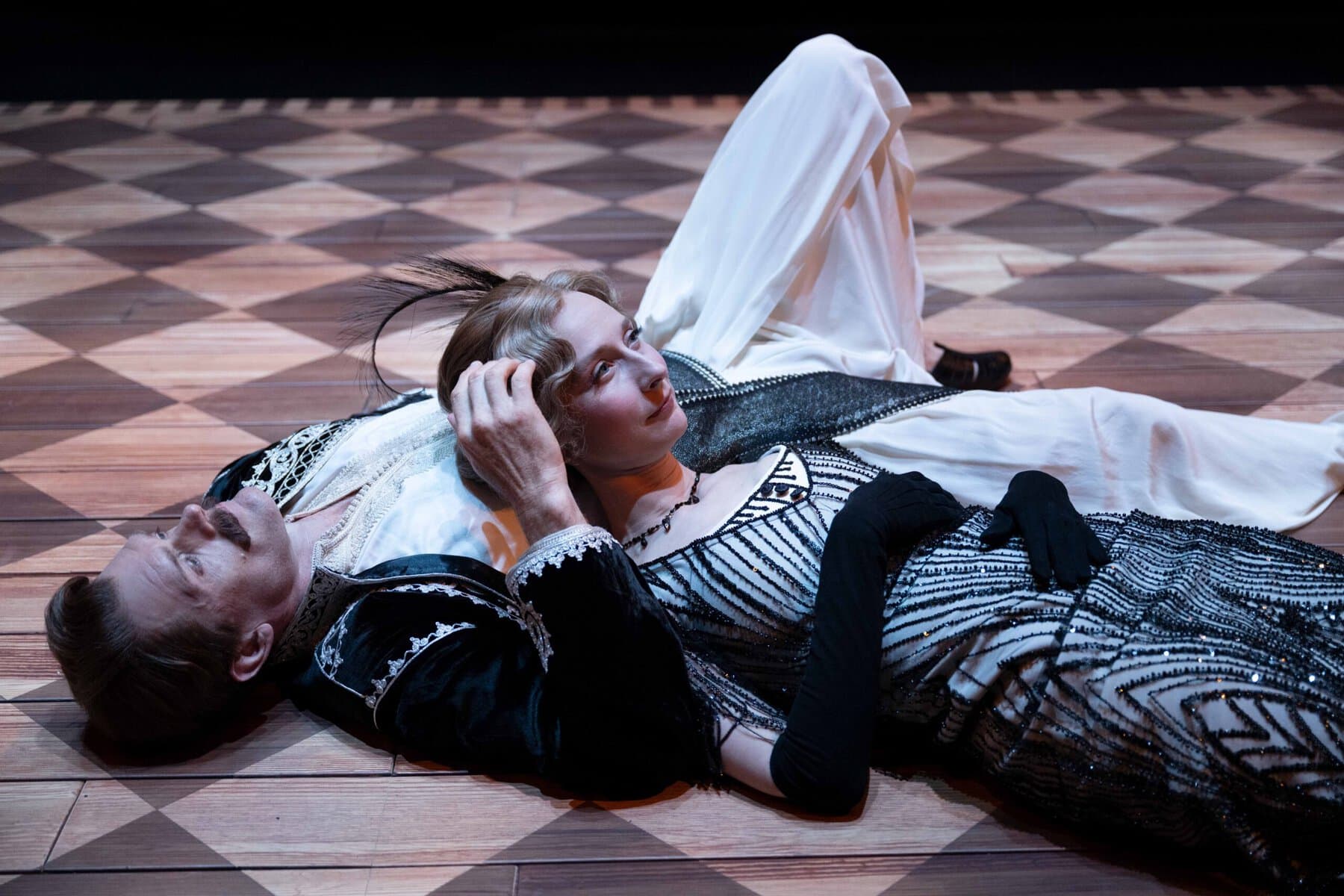
The action of “Heartbreak House” is its narration and its mind game. The set is minimalist, a checkered floor and a few chairs. Its reference to a ship only comes when the captain blows his whistle and commands “To the forecastle.”
This house appears to be a place of sleep and dreaming but it is also a place of gamesmanship. Who will take whom, or fail to take whom, on this chessboard? There are white and black kings and queens and bishops and pawns. They move according to the game. The costumes, cleverly designed by Ximena Pinilla in black and white, are sumptuous or casual as required.
Only at the end, does the reverie and gamesmanship come to an end. The ensemble are out in the garden, musing sleepily after dinner. They hear distant drumming. They become alert. Lights go out. They hear a zeppelin overhead. The nearby Rectory is bombed. The captain’s dynamite in the garden gravel pit explodes. One black king is killed. The game is over.
But it has all been so exciting that they wish the bombing to return the next evening. Fear and danger and adventure has brought meaning to their lives. It would have brought more dynamic meaning to the audience to hear a few of these sounds. Alas, we don’t. The spoken narration tells us.
A moment later, the ensemble becomes melancholic. They wistfully sing Ivor Novello’s 1914 song, “Keep the Home Fires Burning.” It is a poignant end to what might have been.
Penny-Lynn Cookson is an arts and culture historian, writer and lecturer living in Niagara-on-the-Lake.