
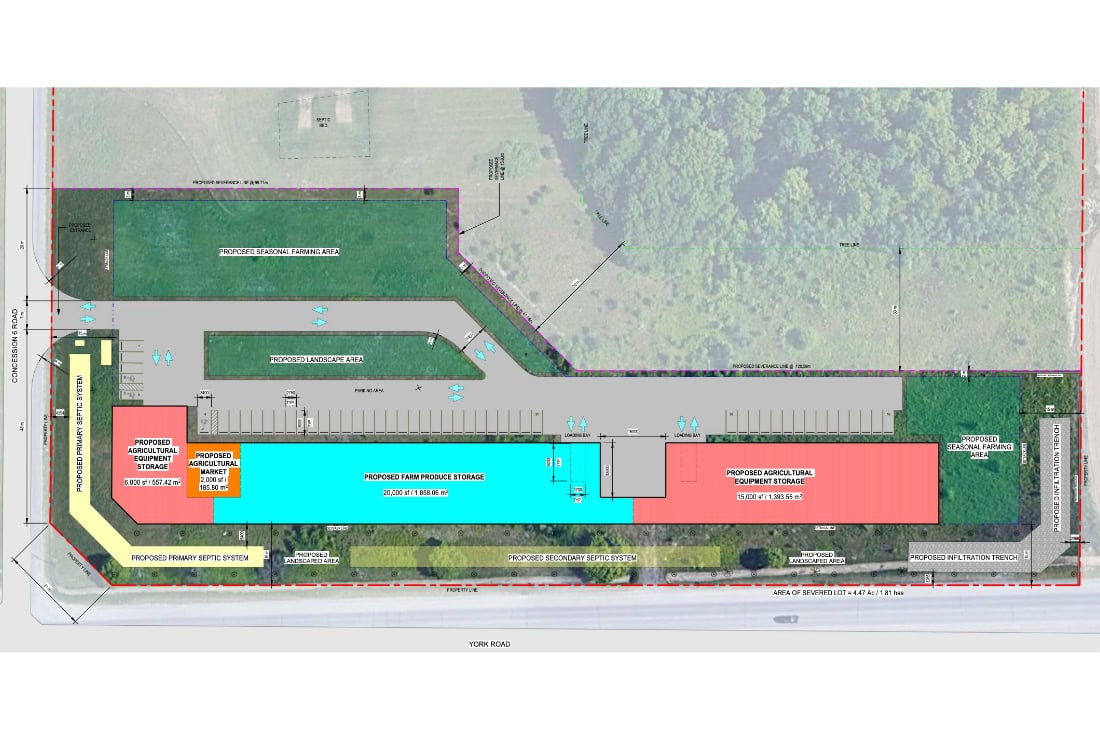


A controversial plan for a large agricultural storage and market hub on protected farmland in St. Davids is once again dead.
Lord Mayor Gary Zalepa attempted to use his provincially given “strong mayor powers” to save it, but failed when council voted against the project for a second time.
The proposal would have allowed agricultural equipment storage, a farm produce storage building and an agricultural market taking up 4,000 square metres total at 263 Concession 6 Rd. in Niagara-on-the-Lake. Council rejected the application 7-1 at committee April 21, before formally refusing the bylaw at council April 28.
The unfamiliar use of strong mayor powers put the bylaw back on the council table Tuesday night. It needed four votes to pass under the strong mayor process, but failed 8-1. Zalepa was the only member of council in favour.
It also turned a fight over one property into a bigger question about how farmland is protected in NOTL and how far the mayor’s special powers can go.
On May 15, two days after the applicants and property owners, Parth Patel and Sejal Patel, filed an appeal of council’s refusal to the Ontario Land Tribunal, Zalepa issued a mayoral direction under Ontario’s strong mayor legislation to bring the bylaw back to council for reconsideration.
Zalepa said he used the powers after staff advised the proposal followed the planning rules governing the property and warned that defending the appeal could cost the town about $50,000 for a one- to two-day hearing.
But councillors were not convinced.
“This is a commercial inflation of our specialty crop soil, where other alternative locations would be better suited for it,” Coun. Sandra O’Connor said.
She said the province’s planning rules are broad, but NOTL has the ability to use stricter wording to protect specialty crop areas.
“This is what we need to do in this particular initiative.”
O’Connor said councillors do not see final site plan conditions so must address concerns now, before a site plan is approved.
“We, as councillorrs, have three main roles: one is financial responsibility, one is policy-making and one is representing the people,” she said.
In this case, she said, the public was clear.
“We’ve heard a resounding, ‘This is not the right initiative in the right location,’” she said.
Coun. Wendy Cheropita called the proposal “almost an abuse of agricultural land.”
“This is an oversized commercial development, commercial enterprise.”
Cheropita said councillors have a duty to protect the countryside and specialty crop land and questioned whether the farming community actually needs what’s proposed.
“I have not found any farmers that are in need of those uses,” she said.
“I think that’s important, because these are people that live here, work the land and protect it,” Cheropita said. “So, I’m very much opposed to this project.”
Coun. Andrew Niven pushed back against the idea that opposition to the project was mostly about how the building would look.
“In the letter that you had sent out,” Niven told Zalepa, “it seemed to be a lot of public concern based around the aesthetics of the building.”
“It was way more than that,” Niven said.
He said the application had gone through several committees and that councillors raised a long list of concerns leading up to this point.
“Sure, somebody did mention the aesthetic side of it. But what wasn’t mentioned was all the other references that us as council and other committees made,” Niven said.
O’Connor questioned the use of strong mayor powers.
She said her understanding was that the powers were supposed to be used to support Ontario’s goal of building 1.5 million new residential units or the infrastructure needed to support that housing.
“This power is being used for an agricultural area for equipment storage, or display for purposes of sale or hire,” O’Connor said.
“Therefore, I don’t feel that the strong mayor powers can be applied to this particular initiative.”
Town clerk Grant Bivol told council the directive could not be amended and that refusing to receive the information report with Zalepa’s direction would not invalidate the directive itself.
He also confirmed councillors were not required to vote differently than they had before and remained entitled to use their own judgment.
Zalepa defended bringing the matter back, saying “the best way you defend the land use in our town is by better policy.”
He said if councillors wanted stronger rules around agricultural-related uses, those policies should have been brought forward earlier.
“Your policy drives what is put in the site plan,” he said. “If there were concerns about agriculture-related uses in certain parts of town, or on certain types of lands, that would be a very good conversation and a policy to bring forward.”
A policy like that could strengthen the town’s official plan and help it “actually, maybe, go win a day at the Ontario Land Tribunal,” Zalepa said.
But those changes would come too late, he said, to help the town fight this appeal.
“Not having the policy is not going to help any of us in the next four months as we go to a hearing,” said Zalepa.
Coun. Tim Balasiuk said he respected Zalepa’s position on policy, but called the situation unfortunate.
“This is one of those situations where, I feel like, it sort of slipped through the fingers,” said Balasiuk.
In the end, council agreed with the decision it had already made and is bracing for a fight at the tribunal.
Paul-Andre Bosc, who runs Paul Bosc Estate Vineyard, attended the Tuesday meeting because of what he described as a “lively” discussion with the lord mayor last week, in which the subject of his plan to use the strong mayor powers to bring the proposal back to life came up.
“I suggested that he should reconsider his actions because I strongly doubted that paving over and destroying prime farmland in favour of a large commercial development constituted a ‘designated provincial priority’ for Ontario,” he said via private message.
“Last night’s even more lopsided 8-1 vote against the mayor showed me, and I’m sure others who witnessed it, that the ill-advised use of the strong mayors act revealed that Niagara-on-the-Lake doesn’t have a strong mayor right now.”