


After his name surfaced in a heated February council debate with then-Niagara Region chair Bob Gale, a Niagara-on-the-Lake resident and former top municipal staffer appeared at town hall Tuesday with a bold pitch: scrap Niagara’s two-tier system for a one-city government he says could save $30 million a year.
Harry Schlange told councillors he believes Niagara should dissolve its current regional structure and 12 local municipalities in favour of what he called “one city, one council” — a single-tier government with one mayor and 16 councillors.
He said he came forward after his name was mentioned during Gale’s Feb. 24 appearance before council, when Gale referenced Schlange’s earlier amalgamation report during debate over governance changes.
Although town officials have said NOTL helped stave off amalgamation for now — after the province chose regional council reforms instead of merging Niagara’s municipalities — Schlange said the issue is far from settled.
“I believe this is not over,” he said.
Schlange said Niagara’s current system is too expensive, confusing and poorly suited to rising costs, aging infrastructure and growing social pressures.
“Niagara’s numbers — they’re not good.”
He said a single-tier government would reduce overlap between the region and local municipalities, creating clearer accountability and allowing faster decisions on housing, planning and infrastructure.
“Single-tier is so accountable,” he said.
“When I did my budgets in single-tier, I knew that, you know, 100,000 people out there knew it was me and their council. We didn’t finger point.”
Schlange said he would return in 18 months with updated figures on Niagara’s financial outlook — a timeline that would place councillors roughly one year into their next term after the October 2026 municipal election.
“Hopefully, the 12 mayors that are running council, the appointed chair and all the municipalities make this happen.”
He pointed to Ottawa, with a mayor and 24 councillors serving about one million residents, and Hamilton, with a mayor and 15 councillors serving roughly 578,000 people. Niagara, he argued, could be governed by one mayor and 16 councillors for a population of about 480,000.
“Municipal boundaries don’t define local neighbourhoods.”
Schlange said the province’s recent governance changes for Niagara were also too limited.
“When I look at what the province announced, I think it was a real missed opportunity,” he said.
“And I’m not sure it’s a victory for Niagara-on-the-Lake.”
A key part of his pitch was projected savings.
Schlange estimated $30 million in annual net savings based on $52 million in gross efficiencies, offset by an estimated $22 million cost to align union contracts and collective agreements across a merged municipality.
He said those savings would come mainly from reducing senior and middle management layers, buying goods and services more efficiently and spending less on outside consultants.
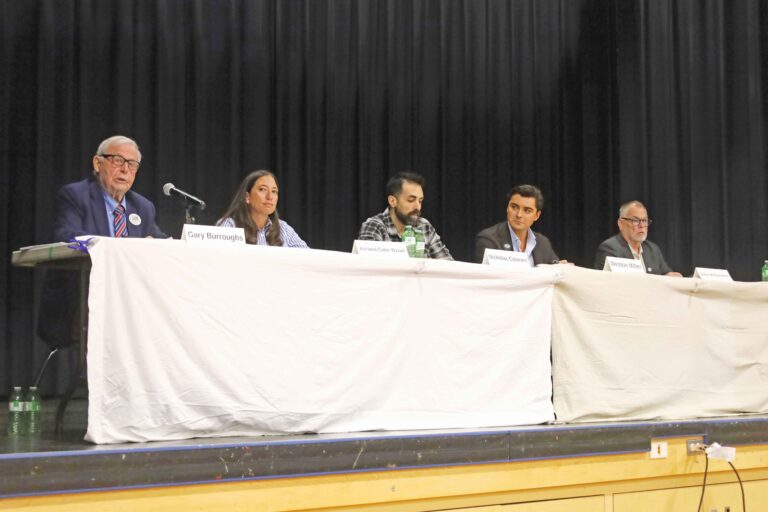
Coun. Gary Burroughs said much of Schlange’s attention was given to management savings rather than elected officials.
“Most of your focus was on reducing staff — I’ve never heard you talk about reducing council. And yet, this seems to be a focus on this particular presentation,” Burroughs said.
Schlange said council cuts were not where the money would be found.
“It is not about reducing council,” he said.
“There’s no financial savings in reducing 126 to the 17 that I’m recommending.”
“All my savings are on the higher-level senior management roles, middle management roles.”
Burroughs also asked about shared services, often raised as an alternative to amalgamation.
“Shared services, to me, is a bit of a facade,” Schlange said.
“You’re not actually saving the money you should be.”
Coun. Sandra O’Connor, citing Ottawa’s past amalgamation, questioned whether well-run communities such as NOTL would lose more than they gain in a merged municipality.
“I, too, was in Ottawa for the amalgamation,” she said.
“How do you address that type of concern, particularly for a community like us, which is quite a rural community?”
O’Connor said amalgamation in Ottawa “was not a win” for municipalities with strong reserves and well-maintained infrastructure.
Schlange said newer restructuring models could protect local reserves and community assets.
“We should learn from that,” he said, arguing Niagara should avoid challenges that arose during Ottawa’s amalgamation.
Schlange previously served as chief administrative officer of Niagara Region, Fort Erie and Grimsby, and also worked in a senior administrative role in Brampton.
“I ran single-tier, upper-tier, lower-tier, at-large council, full-time council, ward council members,” he said. “I’ve also done a number of consolidations in the private sector.”