


Shelley Saywell has a 48-hour rule.
Like most of us with busy minds, she needs a way to be confident that the ideas she pursues seriously are worthy of her undivided attention.
Saywell, 70, moved to Niagara-on-the-Lake during the pandemic, in part, to take care of her aging parents. She is considered one of Canada’s foremost documentary filmmakers and author of a recently published bestselling memoir.
“I have something called the 48-hour rule,” says Saywell. “I get a million ideas in 24 hours, and I think they are all genius. By 48 hours, I’ve discarded 99.9 per cent of them.”
“For me, it’s a semi-joke — but not entirely. If something makes me mad enough for long enough, I think, I’ve got to make that film, as long as its more than 48 hours.”
Her 48-hour rule has propelled her 30-plus-year career.
She has recently donated her film legacy to the University of Toronto’s media commons archives, for use by students in all faculties.
“I wanted the work to reach any student who might be doing their thesis on conflict resolution or violence against women, whatever.”
Not just films. All the raw material from those films. Hours and hours of uncut footage, transcripts, books and audio clips.
Her body of work encompasses some 20 documentaries on social justice and conflict. Her films have been shown in more than 30 countries and collected numerous nominations and awards including Canadian Screen Awards, Hot Docs’ Best Canadian Feature Documentary, an Emmy, Geminis and Genies. Her last film was released in 2016.
Saywell attributes her social consciousness to her formative years in her family home, largely in Toronto, with school-age stints in Hong Kong and Japan.
“I was raised in an open-minded encouraging atmosphere”, says Saywell. “My parents fostered debate at the kitchen table. Every night, we were encouraged to have an opinion and then we were challenged on that opinion.”
Saywell’s father and mother were high-school sweethearts and teenage parents. Her father persevered achieving a degree in Chinese political history.
“My mother had a couple more babies and ended up becoming a social worker. They were very self-made.”
At age 12, Saywell was enrolled in a British school in Hong Kong while her father completed a sabbatical year.
“I joined the debating society and already had, at that age, a social conscience. I knew in my heart that the Vietnam War was wrong. We were surrounded by people who impressed me or inspired me. Activists and journalists.”
By the time she was back in Canada, Saywell was unsure of her future. With a bachelor of arts in hand, she enrolled in the York University Theatre School.
That didn’t work.
She realized that while her fellow students were absorbing their creative studies, she was in the cafeteria with a newspaper wanting to talk about “whatever the hell was going on in the world.”
She asked herself: “How do I marry the part of me that loves the arts and the part of me that’s always driven by the news?”
What did work was a conversation with a guidance counsellor at the University of Toronto.
“She was wonderful. She told me I should be a storyteller. And by the way, there’s a bulletin board over there and there’s a posting for a film company job.”
She applied.
“It was such luck and kismet. What an opportunity. I never went back to school.”
Saywell describes her career-long storytelling focus as social issues.
“Well, social issues slash justice. The films are primarily about the effects of conflict on women and children. I’ve also done two films on homelessness.”
“And one on football, because everyone does one of those,” she chuckles.
After a long pause to think about it, she admits the highlight of her career was probably Kim’s Story.
“It was about the napalm girl, the famous, famous image of Kim Fook that appeared everywhere. It put me on the map. It sold everywhere. I loved Kim and I loved that film.”
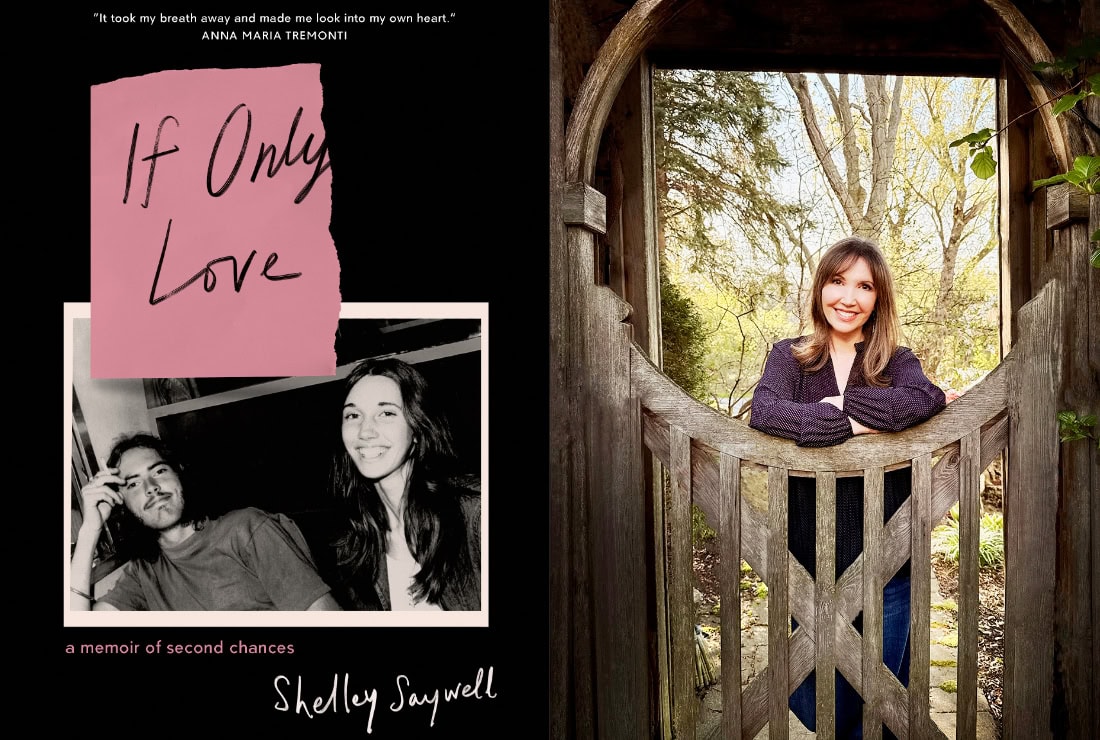
Saywell’s recently published memoir is not her first foray into writing. But If Only Love, A Memoir of Second Chances, is certainly the most personal.
It is a story about profound love, love resurrected and very personal grief. And hope.
“I was grieving for Daniel.”
Daniel was Saywell’s high school sweetheart, found again after 30 years distanced, and, after a complicated rediscovery, husband. Daniel died of cancer soon after they reunited.
“I was very lost. I stared at the wall for months. I was literally incapacitated. I had a hard time leaving my house,” she says. “I wasn’t planning to write a book. I just had to get through this time in my life.”
Saywell saw an advertisement for a memoir-writing course at University of Toronto. The idea survived her 48-hour rule.
“I still wasn’t yet thinking of writing a book, but it got me out of the house and into learning with 14 other would-be writers. It was my safe place.”
Saywell describes the writing process as an escape from the present.
“I was writing about the past, I was happy and happiness is in short supply when you are grieving. I was in a place where Daniel was still alive.”
In a few short weeks, “If Only Love” has become a national best-seller. It is published by Random House Canada.
Saywell says she has at least one more book in her.
“I feel like at this point in my life I’ve been given the gift of choice. And if I’m going to do something new, I’d like it to be without expectations.
“I think it will be a novel. I’ve got a couple of vague notions. Perhaps historic.”
In the meantime, she cares for her ageing parents in old town.
She admits that finding Niagara-on-the-Lake was pure serendipity.
“It was COVID. A good friend who lives here, invited me down, into her bubble. We were out walking and saw a house for sale.”
It passed the 48-hour rule.
“I absolutely love it here. I’ve been a city girl all my life. But I love going to the Legion for fish and chips. And driving along the Parkway,” she says.
“There are so many interesting people here, creative people. In an environment where we can all hang out together. I wouldn’t change it for the world.”