


Linda Grimo has spent much of her life farming in Niagara-on-the-Lake and working at Grimo Nut Nursery on Lakeshore Road, where she has grown and sold nut trees since 1999.
Even with decades of experience with chestnuts and other nuts, she called her February trip to South Korea “up there” among the highlights of her career.
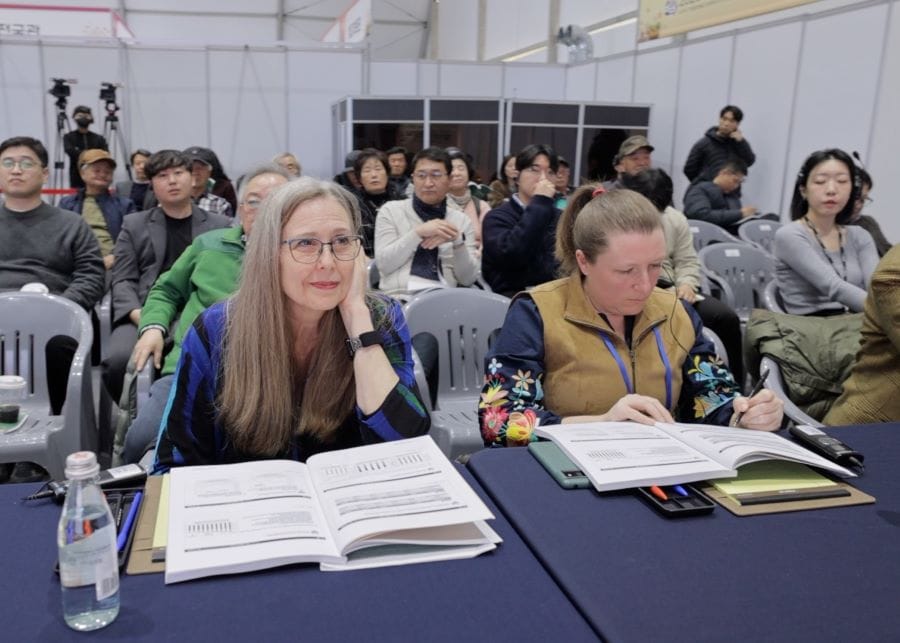
From Feb. 3 to 10, Grimo visited South Korea, including Feb. 4 to 6 in Gongju City for the Korea International Chestnut Expo.
The trip began after she met a City of Gongju employee who visited her farm last July. She said he was bilingual in English and Korean and was sent to learn more about her operation.
“He came to the farm and saw what we do with chestnuts,” said Grimo. “We do sell Korean chestnuts, we grow the trees, we sell the trees, and they’re disease-resistant.”
“He was thrilled with that.”
Soon after he returned home, Grimo received an invitation to attend the 2026 festival — she accepted.
She travelled to the conference with Amy Miller of Route 9 Cooperative in the United States, who holds a PhD focused on chestnut disease and whom Grimo has known for more than 20 years. Miller spoke about chestnuts in the eastern United States.
Other speakers included Francesca Gioacchini of Italy, who presented on “Italian chestnut excellence,” and Sashichi Sakurai of Japan.
Grimo’s presentation, “Growing Chestnuts in Canada: Progress Through Perseverance,” focused on the recovery of chestnuts in North America after widespread disease.
She said chestnuts are native to southern Ontario, where American chestnuts once dominated. In the early 1900s, Chinese chestnut trees were introduced to the United States as landscape trees. They carried a disease to which they were immune, but American chestnuts were not, devastating the species. The outbreak began at the Bronx Zoo.
“These forests were dotted with tree stumps because there was no resistance,” she said. “It’s a terribly sad story of disease introduced into North America.”
Efforts to restore the now-endangered American chestnut continue, but the work is difficult, she said. Farmers have tried developing hybrid Chinese-American chestnuts to improve disease resistance.
Additional threats have emerged, including chestnut weevil, which has affected some southern Ontario growers, and the Asian gall wasp, which has significantly damaged Grimo’s trees.
“We seem to get through one thing and then bam,” she said, noting she grows Korean chestnuts, which are more resistant to gall wasp.
Grimo said Chinese, Korean and American chestnuts are all edible varieties, unlike horse chestnuts.
“When you hear the ‘chestnuts roasting on an open fire,’ that’s what they’re talking about,” she said.
In South Korea, she was struck by how deeply chestnuts are woven into daily life. Gongju City sits in a major chestnut-producing region, and she encountered the nut throughout her trip.
“Even on the airplane, I was eating a Korean stew and it had a chestnut in it,” she said. “Chestnuts were in the pizza as a topping.”
Grimo said she experienced warmth and hospitality throughout her visit and plans to return for the 2028 expo.
“There was such a warm, kind energy from everywhere we went,” she said.
She hopes to continue contributing to global knowledge about nuts. She views chestnuts, walnuts and hazelnuts as essential crops worldwide, valued for food, wildlife and wood.
“When you talk about a real-world crop, you’re talking about chestnuts, walnuts, hazelnuts,” she said. “Those crops are grown in major parts of the world and are important parts of their diet, and in wildlife and in everything else.”