
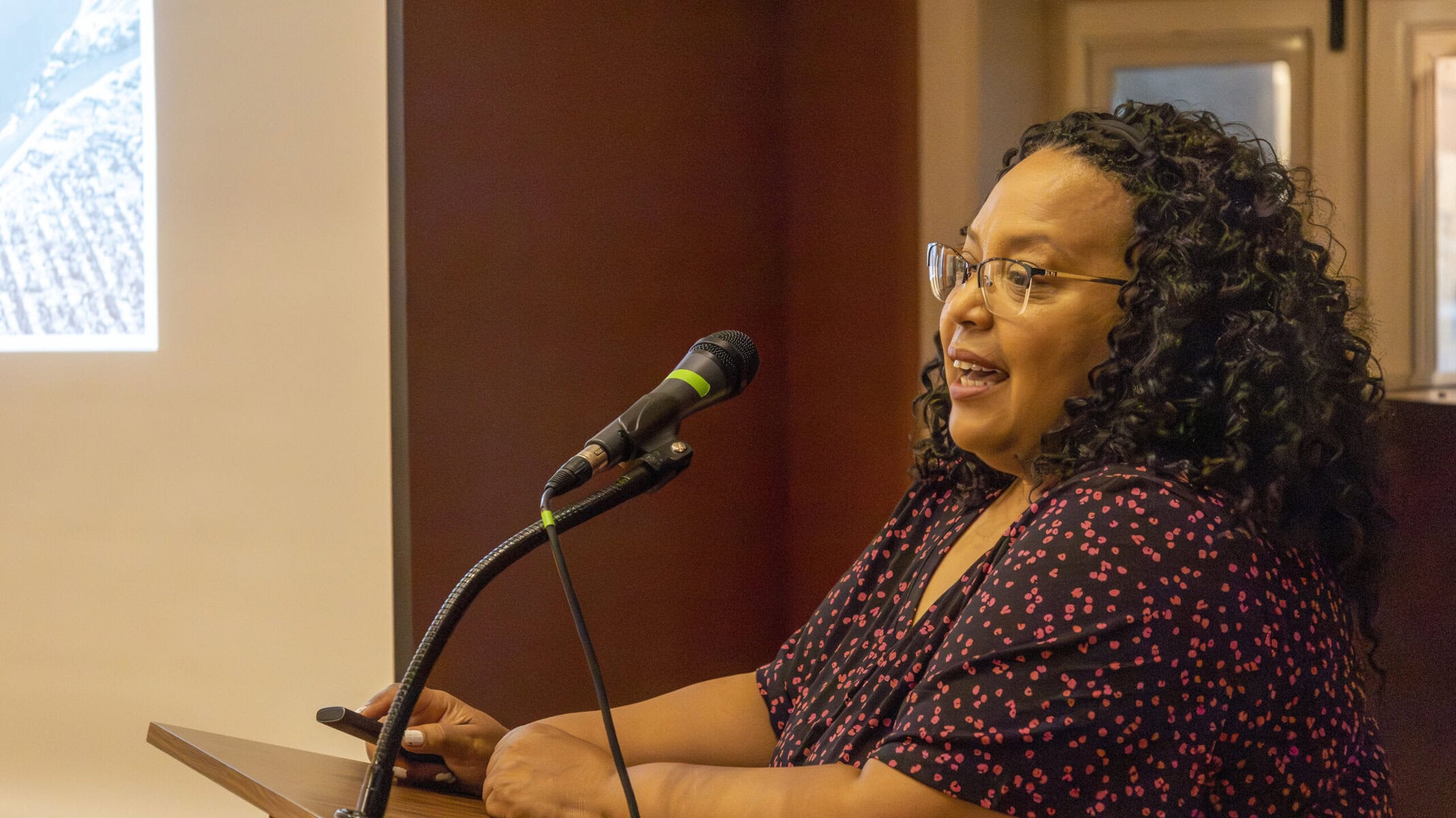


A Niagara public historian says she has uncovered new evidence of anti-slavery advocacy work in Niagara-on-the-Lake, including information about the man who may have been one of the leaders of the Anti-Slavery Society of Canada.
St. Catharines historian Rochelle Bush said she came across documents three months ago detailing information about William Barr, a white man who lived in what was then called Niagara and is now known as Niagara-on-the-Lake.
Right now, based on her research, Barr “appears to be the point person” for the abolition group, she said.
“I was so thrilled to find that.”
The Anti-Slavery Society of Canada formed in 1851 to promote the worldwide abolishment of slavery and support African-American refugees seeking freedom in Canada, a decade before the American Civil War.
Bush’s research is still in the early stages, but she learned about Barr through an 1853 edition of the Provincial Freeman, a prominent abolitionist newspaper founded by Mary Ann Shadd, a free Black woman.
Barr appears in the writings of Samuel Ringgold Ward, a formerly enslaved person who fled Virginia and later became an abolitionist activist, newspaper editor, minister and labour leader in Canada.
Ward travelled through the Niagara area in 1853, the newspaper’s first year of publication. He was accompanied by Hiram Wilson, a white American who served as the area’s contact for the Anti-Slavery Society of Canada and was also a station manager for the Underground Railroad in St. Catharines.
The pair visited what is now NOTL on March 15, 1853. Ward wrote that Barr provided hospitality and organized a meeting.
“In company with our excellent friend, Wilson, we went to Niagara on the 15th, where, through the activity of William Barr, Sen., Esp., a large assemblage was ready to hear us at the appointed hour,” Ward wrote. “Mr. Barr occupied the chair with great ability. A most encouraging meeting was that at Niagara.”
Bush said in an email that Barr likely assisted newly arrived freedom-seekers — formerly enslaved people who crossed the river and landed in NOTL.
She described Barr as a well-known and respected member of the community. An advertisement in an 1858 edition of the Niagara News lists him as a skilled tailor.
Bush said Barr’s activities would have likely taken place throughout the town, rather than in a single location. It may also add a new dimension to Black history in NOTL.
The town’s Black history dates back to the era of the United Empire Loyalists, when enslaved people arrived with white Loyalists and free Black Loyalists also settled in the area, she said.
NOTL later became a destination for people escaping enslavement via the Underground Railroad. One of them was William Riley, who fled Virginia in 1802 and eventually settled in the town in 1819, Bush said.
About 200 Black settlers lived in an area known as the Coloured Village.
“Most towns and villages had a section, usually on the outskirts, that was named the same or something that was identifiable as Black, such as ‘Little Africa’ in Fort Erie,” Bush said. “These areas created safe spaces for Black people. There were also plenty of people who chose to live outside the Black neighbourhood.”
While some Ontario communities had self-sufficient Black neighbourhoods, NOTL’s “Coloured Village” was more integrated, Bush said, with Black and white residents living side by side.
Bush said the community made a strong impression on Shadd.
“I am of the opinion that Shadd came to the conclusion that NOTL was without prejudice after conversing with the residents of the Colored Village and others,” she said.