




When Don Triggs talks about his life and career, his memories are peppered with references to his youth spent in a small Manitoba prairie town. He credits his family and early experiences for his love of the land, his commitment to agriculture, even his business acumen and negotiating skills.
On March 19, Donald Triggs, 82, will be appointed an officer of the Order of Canada in an Ottawa ceremony, one of 80 recipients in 2026.
In making the appointment, the governing body cited, in part, “(his) visionary leadership reshaped Canada’s wine industry … Beyond business, he is a committed philanthropist who supports education and the arts with passion and purpose.”
And it all began in the hamlet of Traherne, Man., population less than 500 (now 1,770), 125 kilometres west southwest of Winnipeg.
“Let’s face it: receiving the Order of Canada is a highlight of my life,” says Triggs proudly. “It somehow says I made it.”
Triggs family emigrated from England in the late 19th century, homesteading land that would with cattle and mixed grains.
“I have pictures of my grandmother pitching sheaves into a threshing machine. We all worked hard.”
The seeds of Triggs’ future were sown, literally, in these Manitoba fields.
After school, Triggs and his twin brother, Ron, worked a lucrative trap line until darkness. Then, their farm chores completed, the two skinned and stretched the pelts, usually ermine, readying them for market.
Triggs laughs when he describes how his relationship with the Hudson Bay fur buyer honed his marketing and negotiating skills.
“He came to town once a month, advertising in the local paper. It was my first lesson in negotiation. A two-foot ermine pelt was generally worth three dollars. He’d offer $2. I’d refuse and walk away. You learned. I’ve used that lesson ever since.”
Triggs was content with a career in farming.
“Farming is a good, good living. I really wanted to farm.”
But fate stood in his way. An uncle’s serious health issue meant only one of the two brothers could stay on the farm.
“My father took us aside and declared that one of us would have to leave the farm. We drew straws and I lost.”
Triggs used the savings from his half of the trapline earnings to enter the agricultural economics faculty at the University of Manitoba, graduating in 1966, the same year he married his wife of 60 years, Elaine, also a U of M honour student.
“The courses that interested me were macroeconomics, econometrics, statistics,” says Triggs. “I took all the options that led me towards business.”
When they graduated, the two moved to London, so he could pursue a masters of business administration at what is now the Ivey Business School.
“It was an eye-opener for me. We were forced to think like a CEO. It really lit a fire under me.”
It was during his time at Western University that Triggs was taken by the wine bug.
“Elaine and I were taken to dinner at a fancy place. We were poor students. We thought a bottle of Mateus and a pizza was special. Our host ordered a bottle of Chateauneuf-du-Pape. He explained to us all the grape varieties in the wine, where they were grown, the soils they were on and how they contributed to the wine’s character.
“This was farming, but there was so much more to it than growing wheat or corn. I was hooked.”
After stints as an assistant product manager for Colgate Palmolive and another at a marketing services company, Triggs was headhunted to help run the Labatt’s foray into the Ontario wine industry.
Finally, he was back with his first love: agriculture.
He was a believer.
He envisioned, along with a few other Canadian new-wine pioneers, an industry making world-class wines that would compete in Europe and around the world.
“We knew that our vineyards were built for ease of production in labrusca grapes. They were not attuned to making quality wines. We had to retrain ourselves — our grower communities. We had to redevelop our thinking.”
To put their money where their mouths were, the Triggs made a six-figure contribution to Brock Univeristy’s cold climate oenology and viticulture institute to enable the school to bring the best and brightest wine makers and technologists from around the world to speak to its budding winemakers and grape growers.
Perhaps Triggs’ best-known business venture is the creation in 1993 of Jackson-Triggs, one of Canada’s foremost winery brands.
He has a funny story about how the would-be winery was named.
“There were five partners when we started Jackson-Triggs. We were going to acquire the Labatt wine business. Basically, we all borrowed as much money as we could, put it into a kitty and then together we borrowed a whole lot more.”
“We did a bunch of consumer research on how to position our new brand. We learned that there were warm fuzzies around brands that used the name of the president and even better if you had two real people in the name, partners working together.”
“So, our marketing director put all the partners’ names into a hat and drew two out: Jackson-Triggs. That simple.”
JT, as it became known over the next decade, was the cornerstone of Vincor International, with wineries and partnerships all over the wine world. Triggs was the CEO and president.
In 2006, Vincor was sold to Constellation Brands, a leading international producer and marketer of a host of wine and alcohol brands. The Canadian operations of Constellation Brands were purchased in 2016 by Arterra Wines, wholly owned by the Ontario Teachers’ Pension Plan.
Triggs moved on.
On a kind of swan song tour across Canada following the sale of Vincor, Triggs began dreaming again of going back to the land, of rekindling his inner farmer.
“I went across the country and said goodbye to everyone. I stumbled across an abandoned peach orchard that would make a wonderful vineyard.”
It got Triggs thinking.
“I talked to Elaine. We thought, well, maybe we should do this. We both love farming.”
In the end, that property didn’t work out. But it was a flame that just wouldn’t go out.
“I found another piece of property that was just gorgeous. Elaine looked at me and said: ‘Don, you buy that site. We’ll do the wine business. We’ll do the winery.’ So, we did it.”
The Triggs had help from their youngest daughter, Sarah, who joined the effort to create the Culmina Family Estate Winery, in Oliver, B.C.
“Sarah jumped at the chance to be a part of the startup. She went off to Australia, did a master’s in wine making and business and then joined us. I was delighted. She was a big, big contributor.”
After 12 successful years, Culmina was sold to Arterra Wines.
The Triggs have two other children. Andrea, their eldest, is married and living in Australia. Melissa lives in Don Mills. They have a total of four grand-children.
In 2018, Triggs received an honorary doctor of laws from Western University.
In addition to spending time plotting how to see their children and grand-children, the Triggs are never far away from divining ways to support their favourite non-profit organizations. Both are members of the Shaw Festival board of governors.
Over the years, they have made significant financial contributions to a long list of recipients, including Western University, Brock University and the Shaw Festival.
“Our love of theatre began during our university years in Winnipeg. A major patron gave tickets to performances to members of the student council. I invited Elaine. It was mind-blowing. It just opened another door for me. It cemented in me the importance of giving back to the arts.”
The Triggs began coming to Niagara-on-the-Lake as young students, camping in an old army tent on the Commons and attending the fledgling Shaw theatre. Over the years, they have moved around a great deal but always returned to town. They currently live along Queen Street, overlooking the iconic fourth hole of the golf course.
“We’re delighted to be back. We love it here. Our neighbours, our theatre — the whole cultural scene. It’s a very special place.”
Triggs is a little anxious about his upcoming investiture ceremony.
“It’s so special. They sent me the little pin. Of course, I will wear it proudly, but I’m petrified of losing it.”
Triggs is close to finishing a book about his life experiences. “Not for publication, but for my great-grandchildren so they can know how it was.”
He may have trouble keeping publishers away.
PHOTOS AND CUTLINES
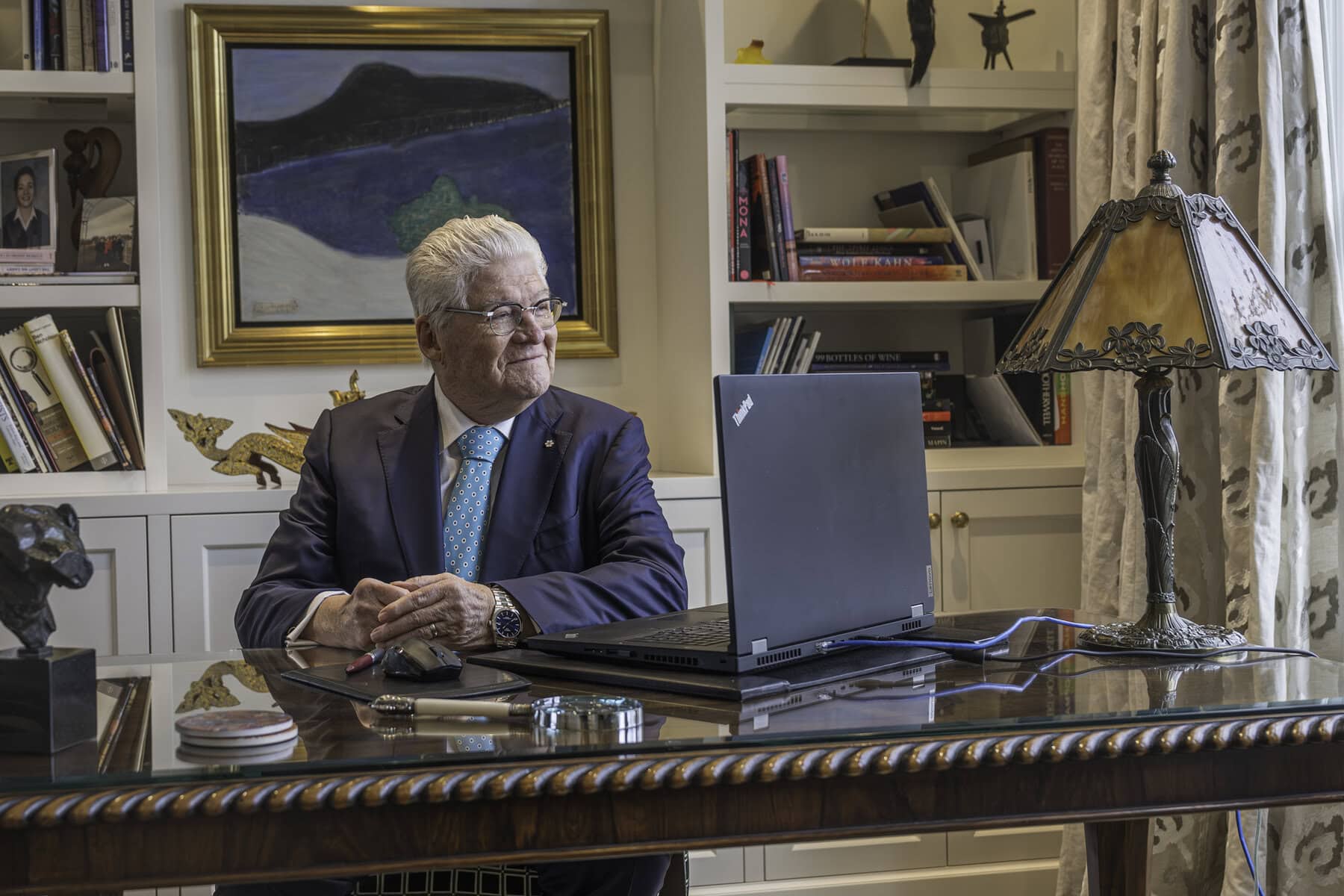
Donald Triggs will be officially appointed officer of the Order of Canada at a ceremony in Ottawa on March 19. He is known for his visionary leadership in Canada’s wine industry and his philanthropy in support of education and the arts.
Donald and Elaine Triggs share a toast to his becoming an officer of the Order of Canada, one of 80 Canadians appointed this year.
Donald Triggs proudly wears his officer of the Order of Canada pin.