
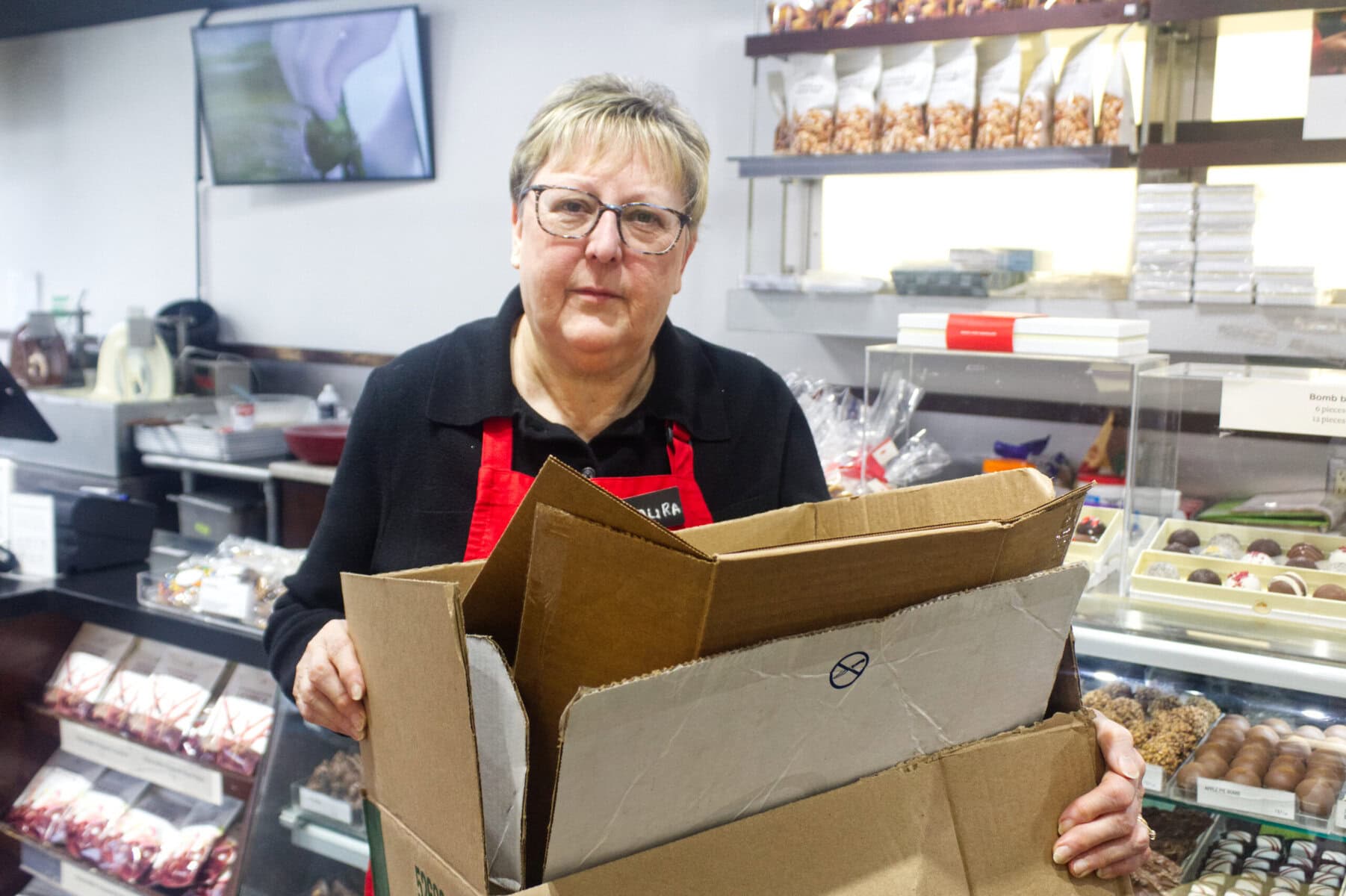


Laura Cochran, the owner of Rocky Mountain Chocolate on Queen Street, uses quite a bit of recyclables in her business serving confectionary products, from chocolate bars to boxed chocolates.
She is frustrated at the province’s decision to put recycling collection in the hands of producers that supply products made of paper, glass, metal or plastic to consumers in Ontario, effectively privatizing non-residential recycling. This change came into effect on Jan. 1.
Apart from the extra costs imposed on businesses, Cochran said she foresees “seven different trucks coming up and down the street” at different times in the future, which she does not think is a good look on a place meant for tourists.
It has impacted her business, and the future looks more complicated in her eyes.
“Long-term, I don’t see how this is going to be beneficial for anybody,” said Cochran.
The move by the province has drawn disapproval from some business operators in Niagara-on-the-Lake.
Some NOTL business owners, including Tommy Wegge of Harmony Lifestyle on Queen Street, said the provincial government did not properly plan for this program.
“In this case, they really don’t — obviously — do not know what they are doing,” he said.
Wegge also echoed Cochran’s concerns about the potential for a lot of trucks to come down Queen Street.
“We would like to see, rather, the customers coming in with their cars instead of cars driving back and forth,” he said.
Before the December holiday break, the town created a temporary program funded through the municipal accommodation tax to collect cardboard from businesses on Queen Street throughout 2026. That includes Rocky Mountain Chocolate and Harmony Lifestyle.
They collect cardboard on Mondays and Saturdays, which Wegge said are “good days for us.”
Coun. Andrew Niven, who also works as director of marketing and hospitality at Konzelmann Estate Winery, said town staff have told him the program is operating as intended.
“Pickups have continued without interruption, and to date, no service issues have been reported to town staff,” he said in an email. “I look forward to receiving progress reports in the near future to gauge service levels and plan for a longer-term outcome beyond 2026.”
Business owners have experienced varying impacts from the change. Katherine McMichael, owner of Lady Lou Collective on Queen Street, said she had some “concern” when this was brought in, but said her business has not been significantly affected.
“We mainly only deal with cardboard, and the town came up with a solution for cardboard being picked up on Mondays and Saturdays,” said McMichael. “So, we didn’t have to find a solution.”
Niven, who works in the winery industry, said like other wineries Konzelmann has not been significantly adversely affected because it has an independent pick-up service.
But for businesses like Cochran’s, she said she sometimes takes plastic recyclables home and asks employees to put them in the garbage because she doesn’t want the extra cost of a private recycle service.
“We’re filling the landfill needlessly,” she said.
Cochran said she is grateful for the cardboard pickup but believes there has been “confusion” during the rollout. She said she has seen three or four trucks pass by with unclear pickup locations.
“I came in here last Friday and there was a pile of cardboard in front of my store, which did not come from my store,” said Cochran. “And there was no pickup on Friday, or so I thought, because it’s supposed to be Monday and Saturday. But sure enough, a truck comes by Friday and picks up the cardboard.”
“Is that a growing pain? I don’t know.”
Beyond 2026, it remains unclear how non-residential recycling will operate in the town. Niven said potential long-term solutions include a centralized recycling drop-off or extending the town’s cardboard collection program, but he said the town will need to adapt if privatization continues.
“We’ll take this year as a learning (experience),” he said.