


Sunday evening marked the first night of Hanukkah in Niagara-on-the-Lake and around the world. Members of NOTL’s Jewish community are celebrating the holiday with family time and reflection.
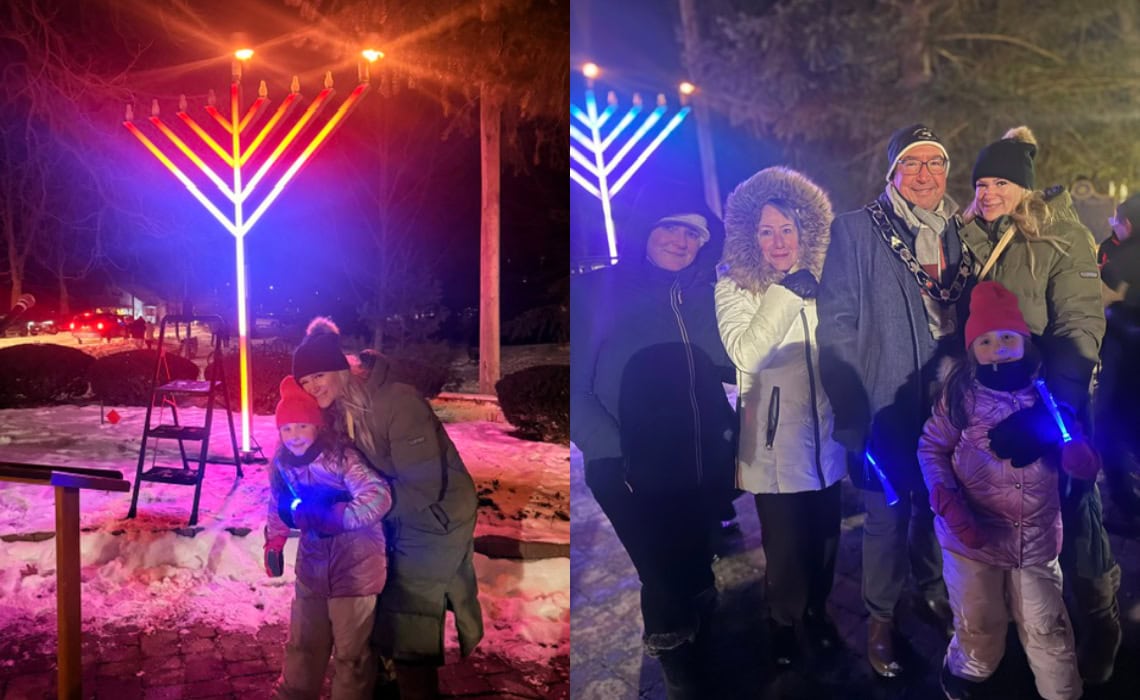
The town marked the start of Hanukkah with a public celebration in Simcoe Park on Sunday evening beside a large lit menorah. Several local officials were in attendance, as well as members of the local and regional Jewish community.
“Lighting the menorah on the first night was very healing and symbolic,” said Perla Zaltzman, who, along with her husband, Rabbi Zalman Zaltzman, operates a synagogue and Chabad Niagara in St. Catharines. The couple spearheaded bringing the menorah to the park.
This is the second year the menorah has been displayed in Simcoe Park, serving as a public symbol of a holiday that is also celebrated privately with family and friends. While Hanukkah traditions include items such as dreidels and specific songs, residents in NOTL observe the holiday in different ways.
Leslie Mann, a NOTL resident who identifies as a “conservative Jewish person,” said Hanukkah, like Christmas, often centres on children. His children are grown up and “don’t follow the holiday very much,” though they still identify as Jewish. Mann described himself as “laid-back” about the holiday but said he continues to observe some traditions.
“There are those Orthodox Jews who follow it to the letter,” he said. “Then there are the average, less Orthodox, more conservatives like me who go along with lighting the candles, maybe a few Jewish foods that are typical to the holiday, you know, potato latkes is one of the major ones. I still try to keep up with a few things like that.”
Mann said most Jewish people he knows in NOTL celebrate in similar ways. His family also blends traditions, as his wife is not Jewish, and they display both a Christmas tree and a menorah.
This year, Mann entered a Hanukkah-themed tractor in the town’s tractor parade in Virgil. He credited Coun. Erwin Wiens and his wife, Dorothy Soo-Wiens, for welcoming its inclusion in what is typically a Christmas parade.
“That is my way of putting it out there to the entire population of NOTL,” he said.
Alana Hurov, a reform Jewish resident of NOTL, said Hanukkah is about family, food and gratitude.
“Lighting the menorah is straightforward; most people will do that,” she said. “Like any holiday, it’s about spending time with your family, having nice dinners … especially over the last few years, it’s about being thankful.”
Hurov runs a page called Jewish in Niagara and said the Jewish community in the region is tight-knit. She attends Chabad Niagara and said she enjoys it, though she does not go to synagogue often.
“There’s really only two synagogues in the region. There is a reform synagogue but there’s not really have the building per se,” she said, adding that reform, conservative and Orthodox Jewish people live throughout the Niagara region.
Zaltzman said Hanukkah celebrations tend to be fairly “uniform,” with differences appearing more in cultural practices, such as foods associated with different regions of the world.
Chabad Niagara serves people from multiple cultural backgrounds. Zaltzman said its approach to Judaism is non-denominational and that distinctions between reform, conservative and Orthodox Judaism are not central to her community.
“It’s a socially constructed design,” she said. “It’s not really reflected in the lived experience.”
This year’s holiday is also marked by grief for many following an attack during a Hanukkah celebration in Sydney, Australia, this past weekend. Two gunmen killed 15 people at an event on Bondi Beach.
Zaltzman said her husband and son knew people who were killed in that attack and she knew the husband of a classmate who was killed at a Jewish school in France in 2012.
Zaltzman studies contemporary antisemitism as part of her PhD research at Brock University. Mann, Hurov and Zaltzman all said they are deeply aware of the presence of antisemitism and its consequences.
Despite this, they emphasized that Hanukkah remains a celebration of hope and light.
“Hanukkah is about cutting through the darkness and seeing the light,” said Hurov. “It’s about hope.”
Hanukkah is an eight-day festival of lights that commemorates the miraculous burning of one day’s worth of oil for eight days during the Maccabean Revolt in the second century before the common era. This year, the holiday runs from Sunday evening to Dec. 22.